Wednesday, April 6, 2011

Types of Wau: Wau Bulan (Moon Kite)

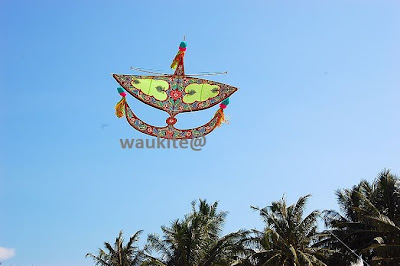
Wau Bulan is a buzz word in Malaysia's traditional kite's world. Perhaps, you landed at this blog because you too search for 'Wau Bulan". Therefore, it is imperative that I blog on this subject at the onset. I will not dwell into history at this point of time. There are so much uncertainties and myths with regards to the origin of Wau Bulan.

Wau Bulan literally means Moon Kite. It derives its name from the shape of its tail that looks like a crescent. It is the most stable Malaysia's traditional kite and an easy flyer suitable for light and moderate wind condition. As a single liner and a flat kite, strong wind will cause instability. A suitable size of a Wau Bulan for recreational flying purposes is a four footer (about 1.2 m). Smaller is unstable and bigger gives much drag, unless you are a seasoned kitesperson; the more drag, the greater the fun.


Like any other traditional kites of Malaysia, the frame of Wau Bulan is made of bamboo strips. The purpose of the Wau will determine the type of material and the extend of the decorations. A Wau meant for display is made of glossy flint coloured papers and will be decorated elaborately; but is too heavy to fly. A Wau meant for recreational flying is made of kite papers with only light decorations, or with a more durable materials like plastics sheets or ripstop nylon fabrics.


However, at national competitions, both beauty and flight performance were considered, and the materials used are limited to those of a traditional Wau only. Therefore, it is up to the Wau-Maker to strike the balance between the decorations and the weight of the Wau. There have been innovation in the construction of a Modern Wau Bulan. This is due to the need of bigger Wau to capture spectator's attention; but at the same time is easily assemble and dismantle. In this context, the use of modern kite materials such as carbon rods and ripstop nylon fabrics come into play. I am among those who subscribe to the innovative idea and have won several awards at national competitions in that category.

The 10 footer Wau Bulan The Launch The Pull The Flight The Reading The Victory!

Tuesday, April 5, 2011

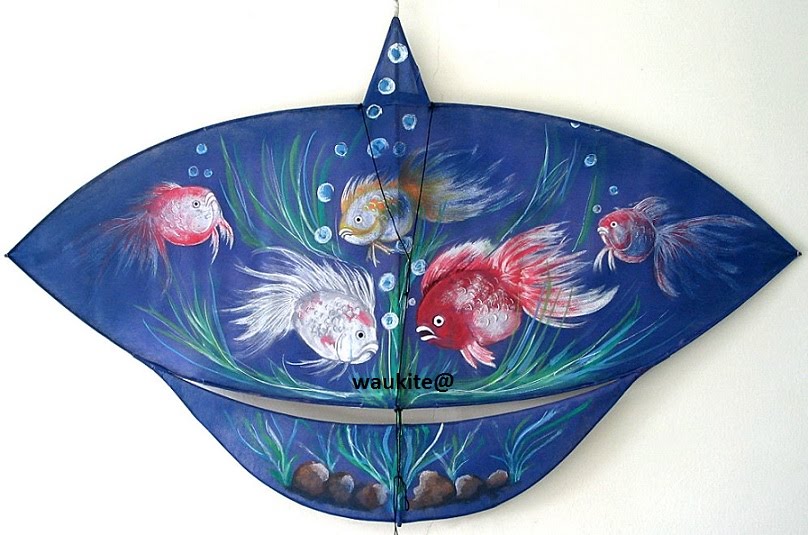
Types of Wau: Wau Daun (Leaf Kite)

This is one of my handmade Malaysia's Traditional Kite called Wau Daun (Leaf Kite). It derrives its name through its shape; unlike that of the Muna Island in Sulawesi which are made of leaves. Wau Daun is an easy flyer during the least wind condition. The frame is made of bamboo strips and the sail is of kite paper. This Wau Daun is handpainted using Fabric Dye and Poster Color.
I am not an artist but this Wau Daun of mine is too beautiful to keep or to fly. So, I donated it to the Pasir Gudang Kite Museum in Johore Bharu for display and safekeeping.

How To Make a Malay Kite

This is a Malay Kite Fighting Competition. The idea is to cut off other participants' kite string. Whichever kite remains the last in the air will emerge as winner. Note that the kite string is standard, issued by the organizer.
This is a Malay Kite or known as Wau Kikik in Malay. It is a tailless diamond-shaped kite. History states that this is among the earliest kite design in the East. It is similar to Eddy Kite or Holland Kite. A Malay Kite is the easiest kite to make. It is an easy flyer provided that it is light, big enough and well balanced. Pictured above is a 3 feet Malay Kite. It is the standard used in the national Malay Kite Fighting Competition.


The vertical stick is the spine. It should be slightly stronger than the cross stick. The cross stick which is just slightly longer is attached to the spine (ensure the balance) by a string at a quarter distance from the top. Then tie the strings at the end of the spine and the cross stick to make the shape. Reinforce with another smaller diamond shaped in the center with a string to provide support to the sail and the frame. Glue on the sail. The sail could either be of kite paper, plastic sheet or the modern ripstop nylon fabric. Attach one point of the bridle where the sticks crossed and another point of the bridle slightly short of the bottom tip of the kite. Finally, attach a kite string and you are Ready To Fly (RTF).


Wanna Fly a Kite?


Assuming that you have made or got a kite; pictured above are the basic kiting gears that you would need to fly a kite. The most important of all is the kite string and a spool to wind the string. Attaching a fishing swivel at the end of the string before it is hooked to the kite's bridle will help to avoid the string being twisted. The strength of the string is dependent on the size of the kite and the strength of the breeze. A simple kite string is good enough for a small kite whereas a bigger kite will require a stronger braided type of string. Avoid using monofilament fishing lines for flying kites as they are sharp and easily cut off when brushed against or crossed lines. You may require a pair of gloves as a taut string can easily hurt your fingers. A multipurpose tool will be handy if you need to cut the string. Happy Kiting.

Wanna Make A Kite?


Having landed at my blog, have you fell for making a kite? It is easy to make a kite and relatively inexpensive. But most all, you will arrive to a satisfaction. All you need are kits that are pictured above; wooden sticks (or bamboo strips), kite papers (or plastic sheets), a pair of scissor, paper cutter, glue and/or adhesive, chord/thread, sand papers and a measuring tape. If you are innovative enough, you can do away with some or replace them with other similar kits.


Google for Kite Plans and enjoy making your very own kites this weekend. Go on, and try it. You will love it.

Tuesday, December 23, 2008

A Tribute to Abd Samad bin Mian - Samad Lefthanded

I am very grateful to Samad - one of Malaysia's best ever guitarist from rock band Lefthanded. He was the one who introduced me to making and flying wau; the traditional malaysia kite. We first met at a Town Park where kids were flying kites. We practically learn to make and fly wau together from scratch. The Above picture was taken during our first outing at 2005 Asia Kite Festival in Kelantan.

As an artsman, Samad has the superb ability to learn quickly. The 'wau bulan' above is one of his first work; but already a wonderful piece of art. It was fielded during the 2006 11th Pasir Gudang Kite Festival. It is still well kept at his home.
Samad was the Champion in the National Competition in the Moon Kite Category at the 2008 4th Borneo International Kite Festival in Bintulu, Sarawak. As I look through my lense to capture his greatest moments on the night of 24 August 2008, I did not realize that his success will be shortlived and brought to an abrupt conclusion. Samad passed away on 23 October 2008. He will be sadly missed and this note is a tribute to him. AL-FATIHAH.

My Fourth First


My fourth First was in the Hornbill Beauty Kite Category at the 2008 4th Borneo International Kite Festival, Bintulu, Sarawak. It is now owned up by the festival organizer; the Bintulu Development Authority.
My other entry in the competition was placed Eighth. It was presented to the Pasir Gudang Kite Museum.

My Third First

My third First was in the Big Moon Kite Category at the 2008 Asia Kite Festival in Kelantan. It measured 10 feet but it was very light, flew almost vertical and the pull was so grrrrrrrrrreat.

My Second First

My second Championhood was a wau in the Modern Moon Kite Category at the 2008 13th Pasir Gudang International Kite Festival. This same kite however was Sixth at the 2007 Asia Kite Festival in Kelantan. It is now owned up by the Pasir Gudang Kite Museum and had since then flown at the 2008 Adelaide International Kite Festival and 2008 Houlgate Kite Festival, France. I also achieved third and sixth placing in the same category and festival.

My First First

My first achievement as the Champion was in the 3D Creative Kite Category at the 2007 12th Pasir Gudang International Kite Festival. The theme was ASEAN Culture; the concept was a box kite; and the object created was a Tuk-Tuk, a common public transport in Bangkok, Thailand. No doubt that it was a team work, but I claimed the mastermindship. To view the Video Clip click here.